

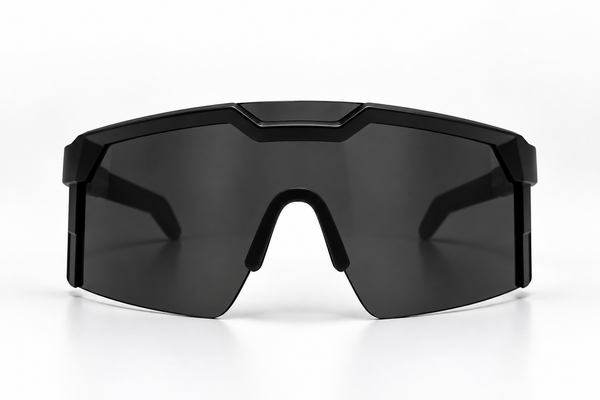
What the markings mean
GLAZI™ safety eyewear carries markings that show what it is designed for. Use them, together with the product page, to decide where a pair belongs.
Z87 & Z87+: protective eyewear
Models sold as safety eyewear are marked to show they are designed and tested to the applicable requirements of ANSI/ISEA Z87.1-2020. A "+" indicates the higher-impact rating: on top of the basic requirements, the protector has passed the standard's high-mass and high-velocity impact tests. Look for the marks on both the frame and the lens of your specific pair. If a pair does not carry Z87 markings, it is not protective eyewear, whatever it looks like.
02 / OSHABasic Z87 meets OSHA's requirement
OSHA's eye and face protection rule (29 CFR 1910.133) requires eye protection that meets the ANSI Z87.1 standard. It does not require the higher "+" rating. For general eye protection, eyewear with the basic Z87 marking meets that requirement.
Check your tool for anything more
Some jobs need more than the basic rating. Before you start, look at the tool or equipment you're using:
- Read the manual and warning labels. Many power tools, such as nail guns, grinders, saws and powder-actuated tools, state the eye protection they require. If it calls for Z87+ (high impact), use a Z87+ rated pair.
- Side shields. Side shields and wraparound lenses add protection against objects coming at your eyes from an angle. They are not a must for every job, only when a hazard from the side has been identified for the type of work you are doing.
- Add other PPE when it's called for. If the manual or the job calls for goggles, a face shield, a welding helmet or hearing protection, wear them as well. Safety glasses alone are not enough.
- Follow your employer's hazard assessment. Under OSHA, your employer decides what protection each job needs. When in doubt, ask your safety supervisor.
Key ANSI/ISEA Z87.1-2020 requirements
Section 5 of ANSI/ISEA Z87.1-2020 sets the fundamental design requirements for impact resistance, coverage and markings. Here is what the main ones require, in plain terms.
Section 5: Fundamental requirements
Every protector must meet all of the Section 5 requirements that apply to it. Unless the standard says otherwise, all measurement values are nominal.
5.2.1: Drop-ball impact resistance
Under the test method in Section 9.6, a steel ball 25.4 mm (1 in.) in diameter is dropped onto the protector from a height of 127 cm (50 in.). The protector fails the test if any of the following happen:
- the lens fractures (lens-only test);
- a piece breaks completely away from the inner surface;
- the ball passes through to the inner surface;
- the lens is not held in the frame.
5.2.4: Minimum coverage area
In front of each eye, the frame, lens housing or carrier, and lens must together cover an elliptical area, seen straight on, of at least 40 mm (1.57 in.) wide by 33 mm (1.30 in.) high, centred on the pupil of the test headform. Protectors designed for small head sizes must cover at least 34 mm (1.34 in.) wide by 28 mm (1.10 in.) high, also centred on the pupil.
5.3.1: Required markings
Every protector must carry permanent, legible markings. Markings for lens type and specific uses are only required when the manufacturer claims protection against that hazard or for that use.
What we don't claim
Z87.1 covers many kinds of protectors and special uses, each with its own tests and markings. We specify which models meet Z87 or Z87+. Unless a product page says otherwise, GLAZI™ makes no claims for any other Z87.1 special-use rating, such as splash, dust, welding or radiation protection.
04 / CARE & INSPECTIONInspect, maintain, replace
Impact-resistant does not mean unbreakable, and no eyewear gives unlimited protection. Protection drops when eyewear is unmaintained, scratched, misused or damaged. Before every use, check your glasses for cracks, chips, heavy scratches, warping, loose or broken parts, or anything that distorts your vision. If you find any of these, stop wearing them and replace them.
- After an impact: retire the pair, even if you can't see damage. Hidden damage can weaken the lens or frame.
- After chemical contact: stop using the pair. Solvents and harsh chemicals can weaken lens and frame materials.
- Keep them as delivered: safety-rated glasses should be worn exactly as assembled by GLAZI™. Taking apart any Z87 or Z87+ marked pair voids all safety claims, and we can no longer stand behind its strength or impact resistance.
- Clean gently: use mild soap, water and a soft lens cloth. Avoid paper towels and abrasive cleaners that scratch.
Where our eyewear isn't enough
Safety glasses are one layer of protection, not the whole system. At work or school, they do not replace machine guards, engineering controls, training or safe work practices, and should always be used alongside them.
Unless a product page specifically says so, GLAZI™ eyewear is not suitable for:
- Heavy impact work: chipping, grinding, machining, masonry, riveting and sanding.
- Heat: furnace work, pouring, casting, hot dipping, gas cutting and welding.
- Chemicals: liquids, acids, chemical handling, degreasing and plating.
- Dust: woodworking, buffing and other dusty conditions.
- Replacing goggles or face shields wherever your hazard assessment calls for them.
Tinted & mirrored lenses
Dark, tinted or mirrored lenses cut the light reaching your eyes. Don't wear them indoors, at night, while driving in low light, or anywhere reduced visibility could put you at risk. Never use any sunglasses to look directly at the sun.
06 / YOUR RESPONSIBILITYFit & the right choice
Every face is different. It is the wearer's responsibility to make sure their eyewear fits properly, stays secure and gives the coverage the job requires, and to take great care in choosing eye protection that meets the applicable standards and the requirements of the tools being used.